Local Ecotype
Large tree, up to 100’
Moist to medium soil
Blooms in spring, edible nuts in fall
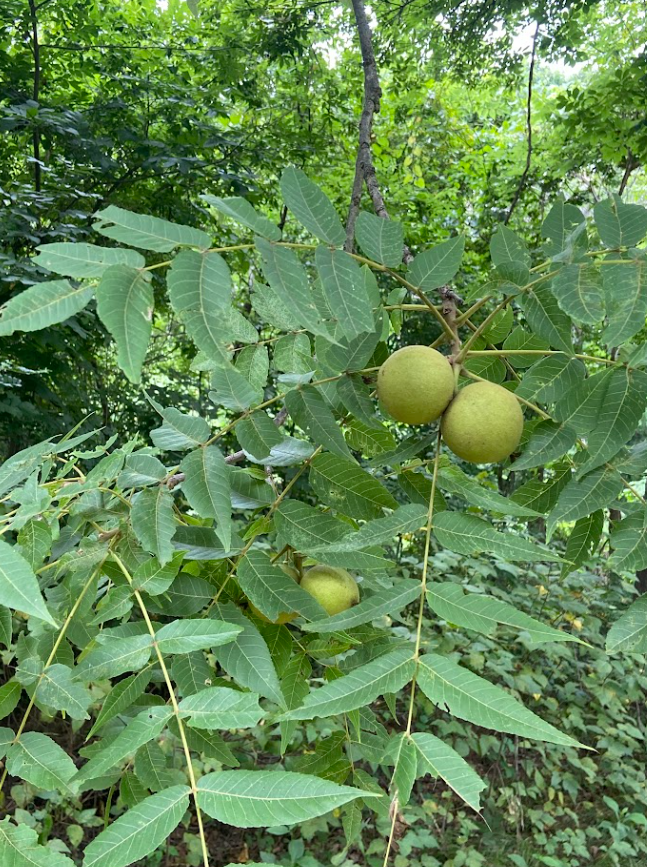
A handsome bottomland tree that produces oily edible nuts. Black Walnut has long been prized for its beautiful, high quality wood. The nuts, ripening in early fall, are eaten by squirrels and other mammals, and have a distinct taste that is wonderful in ice cream or nut brittle. The spicy-scented pinnately compound leaves feed dozens of insect species, including hosting numerous moth caterpillars. The nut husks can be used to produce a brown dye. Black Walnut roots release an allelopathic chemical called jugalone that can affect nearby plants such as tomatoes, though many native plants bear resistance to jugalone. Walnut trees may begin producing a few nuts at a relatively small size, sometimes at around 12-15 feet. This long-lived tree can reach 100 feet in ideal conditions. Prefers deep loamy or sandy soils.
Local Ecotype
Large tree, up to 100’
Moist to medium soil
Blooms in spring, edible nuts in fall
A handsome bottomland tree that produces oily edible nuts. Black Walnut has long been prized for its beautiful, high quality wood. The nuts, ripening in early fall, are eaten by squirrels and other mammals, and have a distinct taste that is wonderful in ice cream or nut brittle. The spicy-scented pinnately compound leaves feed dozens of insect species, including hosting numerous moth caterpillars. The nut husks can be used to produce a brown dye. Black Walnut roots release an allelopathic chemical called jugalone that can affect nearby plants such as tomatoes, though many native plants bear resistance to jugalone. Walnut trees may begin producing a few nuts at a relatively small size, sometimes at around 12-15 feet. This long-lived tree can reach 100 feet in ideal conditions. Prefers deep loamy or sandy soils.